In this Time of Disruption, Let Your Presence Be Known

I offer the following prayer for staff and patients affected by the recent accidental flood at Surrey Memorial Hospital’s Emergency Department.  I am grateful to L. Annie Foerster and her collection of prayers in For Praying Out Loud  for providing inspiration.

K20_3051-640

Photo credit: fine_idea

Honoring the diversity of our spiritual heritages and the unity of our human condition let us join our hearts in a spirit of prayer for all affected by the accidental flood at Surrey Memorial Hospital’s Emergency Department.

Sustaining and creating Spirit, be vitally present to administrators, project leaders, and medical officers as they work tirelessly to assess the damage, put in place interim measures and restore services.

Spirit of Life, we give thanks that no patients were harmed and that only one staff person was injured.  We pray for her recovery at home. Bring peace to the patients that have been transferred to other sites or re-directed to other medical centres. Let your presence be known and resettle their hearts in your love

Spirit of Love, we give thanks for families caring for loved ones. Let your presence be known through the warmth of their hands as they reach out to touch and comfort and soothe.

Spirit of Compassion, we give thanks for all caregivers and front-line staff and for their willingness to do whatever is right and necessary for the well-being and safety of the persons they serve. Through their commitment and selfless giving let your presence be known.

At the heart of our healthcare institutions is a community of care. We are bound to one another. We belong to and with each other. Holy One, whom we call by different names, as Fraser Health staff, administrators and community partners seek to embody your love in the work of caring–especially in this time of disruption–let your presence be known. So be it. Amen.


Standard

We Will Remember Them


Media_httpwwwveterans_fzjqi

Photo credit: http://www.verterans.gc.ca

They shall grow not old, as we that are left grow old;
Age shall not weary them, nor the years condemn.
At the going down of the sun and in the morning
We will remember them.


Standard

On this Thanksgiving Day in Canada I ponder the question,”How can I justify sitting down with family and friends around a feast of plenty when women are being raped in refugee camps, when children are forced to be child soldiers, and the homeless on our own streets abandoned and demonized?” Is not such indulgence in the face of the overwhelming suffering and injustice in the world a callous turning away or “a fatalistic shrug of the shoulders“?

Of course, I am not the only one to struggle with the meaning of thanksgiving. Ann Voskamp provides an answer to my moral distress with her arresting insight:

I know there is poor and hideous suffering, and I’ve seen the hungry and the guns that go to war. I have lived pain, and my life can tell: I only deepen the wound of the world when I neglect to give thanks. . . 

from  A Thousand Gifts: A Dare to Live Fully Right Where you Are

image 

Photo credit: Al Jaugelis

I am also inspired by the embodied wisdom and witness of the African American Church who understand thanksgiving as “a tenacious hold on  the possibility of goodness and justice in spite of present circumstances.”

Here is an excerpt from the hauntingly beautiful poem, by Howard Thurman for whom thanksgiving was a sacrament–an expression of tenacious faith “in the face of death-dealing circumstances“.

 A Litany of Thanksgiving

Today, I make my Sacrament of Thanksgiving.
I begin with the simple things of my days:
Fresh air to breathe,
Cool water to drink,
The taste of food,
The protection of houses and clothes,
The comforts of home.
For all these I make an act of Thanksgiving this day!

I bring to mind all the warmth of humankind that I have known:
My mother’s arms,
The strength of my father
The playmates of my childhood,
The wonderful stories brought to me from the lives
Of many who talked of days gone by when fairies
And giants and all kinds of magic held sway;
The tears I have shed, the tears I have seen;
The excitement of laughter and the twinkle in the
Eye with its reminder that life is good.
For all these I make an act of Thanksgiving this day.

I pass before me the main springs of my heritage:
The fruits of labors of countless generations who lived before me,
Without whom my own life would have no meaning;
The seers who saw visions and dreamed dreams;
The prophets who sensed a truth greater than the mind could grasp
And whose words would only find fulfillment
In the years which they would never see;
The workers whose sweat has watered the trees,
The leaves of which are for the healing of the nations;
The pilgrims who set their sails for lands beyond all horizons,
Whose courage made paths into new worlds and far off places;
The saviors whose blood was shed with a recklessness that only a dream
Could inspire and God could command.
For all this I make an act of Thanksgiving this day.

I linger over the meaning of my own life and the commitment
To which I give the loyalty of my heart and mind:
The little purposes in which I have shared my loves,
My desires, my gifts;
The restlessness which bottoms all I do with its stark insistence
That I have never done my best, I have never dared
To reach for the highest;

The big hope that never quite deserts me, that I and my kind
Will study war no more, that love and tenderness and all the
inner graces of Almighty affection will cover the life of the
children of God as the waters cover the sea.

All these and more than mind can think and heart can feel,
I make as my sacrament of Thanksgiving to Thee,
Our Father, in humbleness of mind and simplicity of heart.


A Sacrament of Thanksgiving

On this Thanksgiving Day in Canada I ponder the question,”How can I justify sitting down with family and friends around a feast of plenty when women are being raped in refugee camps, when children are forced to be child soldiers, and the homeless …

Image

Words and Worlds

Today’s global observance of International Literacy Day brings to my mind a couple of vignettes from my childhood…

My parents had tucked me into bed, switched the ceiling light off and said good night as they closed the door to my room. I waited quietly in the darkness for a few minutes to make sure they thought I was asleep. With my parents chatting in the kitchen while finishing up their evening chores  I was “safe” to begin my nightly adventure.  I reached for my bedside table light and put it under my quilt. Then came the tricky part–turning on the switch that always seemed to click too loudly and risked arousing my parents’ curiosity. As soon as I passed that hurdle undetected I was free to begin my nightly reading adventure under the covers with Nancy Drew

Media_httpphotogoodre_puhmd

I grew up in Ville St. Michel, a primarily French Canadian working class neighborhood in Montreal which attracted a large Italian immigrant population supplemented with a smattering of Poles, Ukranians and other displaced Europeans from World War 2. (Low rents and cheap housing have continued to draw more recent waves of immigration from Haiti, Asia and the Arab world to my former neighborhood). My father spoke English as a second language but he enjoyed reading The Montreal Gazette in addition to the Canadian Lithuanian weekly paper. Although he only had a grade school education and was limited in how much help he could offer me with my school work he knew the value of books and reading to open a child’s mind to a larger world. And so one Saturday a month–regardless of how tired he was from the rigours of his blue collar job–he would drive me for a visit to the regional library.

Media_httpuploadwikim_efexj

Bibliotheque de La Petite Patrie

Photo credit: By Jeangagnon (Own work) [CC-BY-SA-3.0 (http://creativecommons.org/licenses/by-sa/3.0)], via Wikimedia Commons

The high ceilings, big spaces and old wood staircases provided a rich and welcome contrast to the claustrophobic dimensions of our row house. Delighted,  I would scurry to the children’s section, plop myself on the floor and comb the low bookshelves searching for books from my favorite non-fiction geography series–similar to the ones here. I was always sad to leave, but somewhat comforted by my armful of books, knowing that between their covers were words and images that would take me to far away places and lands until my next visit.  

image from http://www.facebook.com/arrondissementRPP


Dear readers, how has reading influenced your life or the life of someone you know? 

Try out some of these activities to celebrate International Literacy Day!


Standard

Bearing Witness with the People of the Casteless God

Oh my mind remember God for he shall remove all the sufferings…

As I read this english translation of the lyrics of “the Song of Bliss” projected on the overhead screen at the Candlelight Vigil at the Guru Nanak Sikh Gurdwara in Surrey, BC my own mind couldn’t help but think of parallels in the Jewish-Christian Bible, especially in the Book of Psalms:

Oh my soul, bless the Lord ...who heals all thy diseases…and forget not all his benefits…. (Psalm 103)
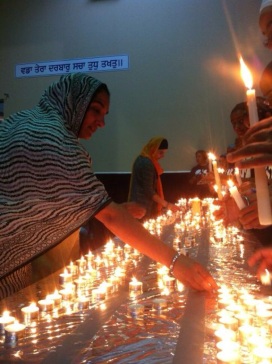
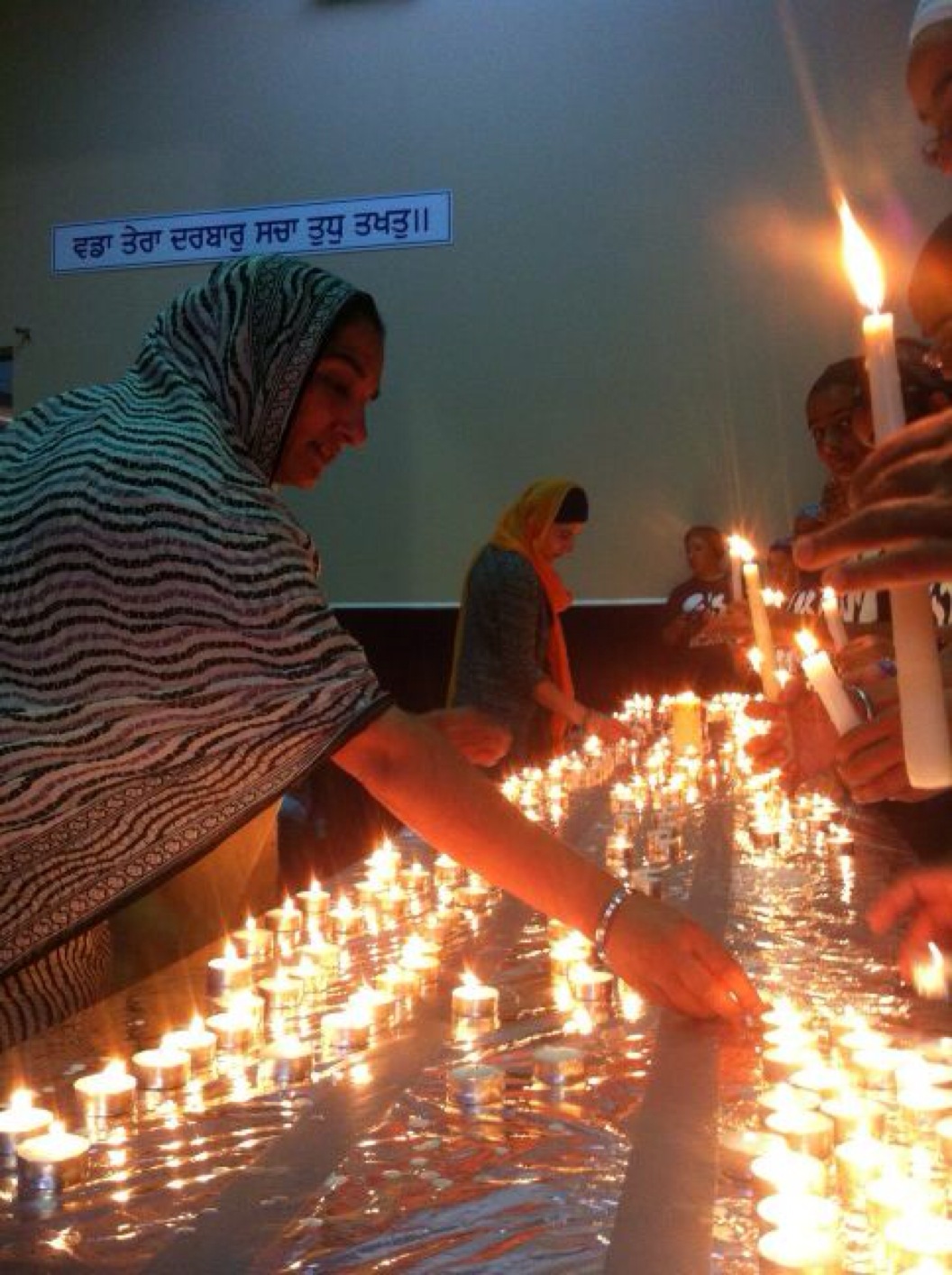
Sikhvigil Women light candles at the August 7 prayer vigil at the Guru Nanak Gurdwara in Surrey for the vicitms of the mass shooting of six Sikhs at the Oak Creek Gurdwara in Wisconsin on August 5. Photo credit – Sikh Community of BC on Twitter, @BCSikhs Another phrase from the Sikh scriptures, “…His caste is casteless” evoked for me the egalitarian God of the New Testament for whom:

There is no longer Jew or Greek, there is no longer slave or free, there is no longer male and female… (Gal. 4:28)

Earlier in the service, I was also struck by how the words offered by the president of the Gurdwara were not that different from what I would expect to hear from a Jewish rabbi or Christian pastor similarly charged with consoling the faithful in a time of tragedy. With gentleness and compassion Bikramjit Singh reminded us about human frailty and God’s merciful nature, and the need to practice forgiveness. While these similarities in no way erased the distinctives between my Christian faith and that of my Sikh hosts or between exclusive truth claims that may come into conflict with one another, my encounter in the Gurdwara with a merciful God who in freedom weaves through the sacred hymnody of both traditions, who exhorts us to compassion and forgiveness, and in whose eyes all are created equal spoke to me not of difference but of our common humanity. As a speaker at another candlelight vigil aptly said:

… our foundational desires, the things we wish for our families and the prayers we offer to heaven are so much more similar than they are different.

In spite of our common humanity it is still so easy to live inside a bubble sealing ourselves off from the perspectives and experiences of our neighbors.  Although my work as a chaplain brought me into weekly contact with staff, clients and families from the South-Asian community I had never visited a Gurdwara before. Not knowing what to expect I naturally had felt a little anxious on my drive out to the prayer service.  Normally at ease and “in the driver’s seat” navigating the spaces of home, work and church located inside my own personal bubble, as I drove through the gate of the complex, I now felt self-conscious as the conspicuous outsider asking for directions. Perhaps this reluctance to risk losing our usual sense of control when we step outside our comfort zone helps to explain why Christians were not present in greater numbers at the prayer vigil. Sadly, I suspect that an even a bigger factor is a theological barrier erected by some Christian churches and sects that prohibits their members from participating in the prayer services of other faiths, equating such services with “devil worship.” What is most disturbing about such harmful convictions is that they are adopted in blind faith without true knowledge and continue to spread like a virus infecting hearts and minds with fear of the dangerous “other”. Although speaking about walls of a different kind–those erected on the basis of class and ethncity–the following words of Rowan Williams apply equaly well to those who demonize their neigbors’ faith.

One [should] be wary about localizing the Devil, but [he is present] anywhere and everywhere that barriers are being reinforced between people.

There was a time when I was also wary of participating in the prayer services of another tradition for fear that such participation would somehow contaminate or compromise my own faith.  As I acquired a healthier theology that makes room for my neighbor’s religious beliefs I discovered that my own faith is not weakened through interfaith encounters but strengthened. By allowing the sacred music, prayers and hymnody of the Sikh tradition to have an impact on me, my Christian worldview was was not threatened but enlarged. My experience of the sacred while praying with the Sikh community broadened the context in which I read and hear the texts of my own tradition.  That context now includes sitting beside a young girl not more than eleven or twelve years old,  who graciously answered my questions about her faith and who told me about the importance of Charhdi Kala, a spiritual  discipline of cultivating a mindset that never despairs and refuses to be crushed by adversities. And it includes the poignant witness of men, women and children chanting, “waheguru, waheguru, God is good, God is good ” in the face of their grief and pain. Far from compromising my faith my Sikh brothers and sisters enriched it. To those who reinforce barriers by falsely labelling people as evil  I ask, “Is not falsely labelling people as evil one of the characteristics of evil? Is it not the sin which nailed Jesus of Nazareth to the cross? In the face of hate and violence rather than build barriers or insulate ourselves in our bubbles we need to build bridges across our differences. In his comments on the social and spiritual benefits of dialogue between Sikhs and Christians  Archbishop of Canterbury, Rowan Williams reminds us:

…that in a world of plural convictions and diverse communities, one of the most important things to which God calls us, is our willingness to take risk. Not just for own dignity and conviction, but for the dignity and the conviction of the other, the neighbor, the stranger…  

Friends, What stops us from taking the risk to know people of other faiths? And to my Christian brothers and sisters something to ponder: In the wake of the recent attacks on different faith communities, what would Jesus do if he lived where you live now?

Standard

Prayer for Light in the Dark Woods

The story of the Vatican’s investigation and highly critical report on the activities of the Leadership Conference of Women Religious (LCWR) has captured my heart. A big reason is because of the role that Catholic sisters have played in my own spiritual and theological formation. I grew up Roman Catholic and they were my first teachers and role models. As a teenager, they listened without judgment as I brought my existential questions and doubts to them, and in my seminary studies some of the best thinking in theology and spirituality that I was introduced to came from catholic women religious. Joan Chittister was among them.  In addition to being a prolific writer, Joan Chittister has also served as past president of the LCWR. Upon receiving an award for outstanding leadership in 2007 she retold this Hassidic tale: 

“Master,” the disciple confessed, “when I study or join others in great feasts, I feel a strong sense of light and life. But when it’s over, it’s all gone. Everything dies in me.” And the old rabbi replied, “Ah, yes, of course. It is just this feeling that happens when a person walks through the woods alone at night. If another joins the traveler with a lantern, they can walk safely and joyfully together. But if they come to a crossroads and the one with the lantern departs, then the other must grope her way along — unless she carries her own light within her.”

In words that ring eerily prophetic in light of the events of this past week, Chittister went on to say that: 

There are two churches in the woods, it seems: the church of Vatican I and the church of Vatican II. The question now is, will the two become one again — preserving the best of the past but bringing the light of the new? Or will they struggle so much for ascendancy that the Gospel gets lost in a morass of institutionalism, as it did after Trent?

And religious life is at a crossroads, too. Has it died or is it simply being born anew? The problem is that the answers to all those questions depend on you and me. They depend as never before on the fresh, new, creative leadership we bring to the crossroads. And it all comes down to the quality and the strength of the light within us. Most of all, it depends on whose light we ourselves are following and what lights we ourselves seek to ignite and leave behind.

(you can find a link to the full text of Joan Chittister’s remarks here)

photo

I  continue to be grateful for the light of faith ignited in my heart by the witness of Roman Catholic sisters. With countless others, I had hoped that the reforms initiated by Vatican II would continue to propel the Church towards an ever deepening commitment to make the gospel and God’s liberating love concrete for our times. Sadly, when I came to my own spiritual crossroads I discovered that I no longer belonged in an intransigent church steeped in patriarchy whose male hierarchy claims divine authority exclusively for itself.  

As Margaret Swedish observed in her reply to a post by New Ways Ministry, this is indeed an extraordinary moment for LCWR, women religious and the US church. Together with all for whom Catholic sisters’ unstinting commitment to work for social justice serves to deepen their own faith or strengthen them in their own vocation I, too light my candle and pray for courage, deep wisdom and continued faithfulness to the gospel of Christ rather than the edicts of men. 


Standard

People of Hope – The Young Citizens of #OccupyTogether

Occupyvancouver_oct15_2011

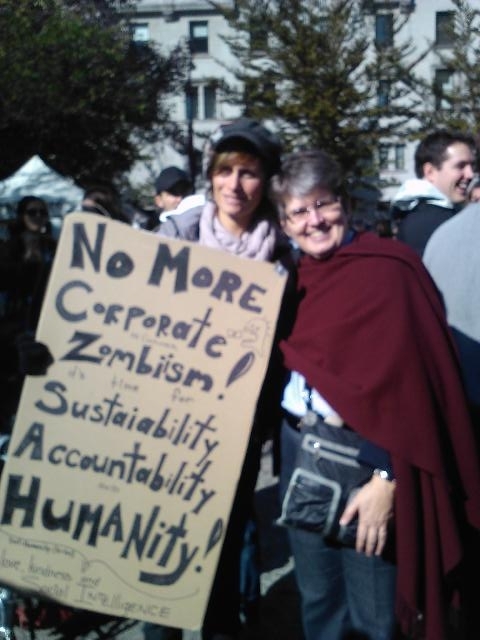
With OccupyVancouver friend Kerri-Ann, who gave me  permission to share this photo.

When I arrived at Occupy Vancouver, well after 11:00 AM yesterday, it seemed the General Assembly had been struggling all morning to arrive at a consensus about process. As painful and clumsy as the consensual decision-making process itself seemed to be, what I witnessed moved me –a grassroots effort and commitment to have “government of the people, by the people, and for the  people.” It was a large crowd, and many–unfamiliar with this entirely new way of thinking were growing impatient with the lengthy “process about process.” But as someone said in this  video from OccupyNYC about the consensus process, “even though it is messy and complicated and slow…it is in the hashing out of things that we can actually change the system.”

Journalists and academics have recently raised the alarm about the decline in voter turnout. This morning while checking my twitter feed, I came across the following column at iPolitics.ca by Robert Asselin, Democracy at Risk, as Cynicism and Disengagement Grows. Here is my response:

The young citizens behind the Occupy protests are neither complacent nor have they stopped caring. They are outraged at a political and economic system which marginalizes them and leaves them with a sense of powerlessness to effect change. As you point out in your article, their representatives in Ottawa and provincial capitals have betrayed their trust by deciding “to go with the nasty rhetoric and low blows” instead of engaging in “substantive debates on climate change or economic policies.” However, instead of tuning out as you assert, they are in fact trying out the remedies within their means to fix our democratic malaise. Through embracing a consensual model of decision-making in their general assemblies and experimenting with direct democracy they are committed to honoring every voice—not only those who agree with the moderators’ proposals. They’re hope is that when decisions are made, those with dissenting points of view will nevertheless be able to live with the decisions being made because of the integrity of the process, something which they see sorely lacking in Ottawa.

The young people at the forefront of the Occupy protests not only love their country, they have a planetary consciousness and are pursuing ideals that point the way—however imperfectly—out of a system of “haves and have nots” to a world in which all are welcome at the table.

The young people that I met and spoke with at Occupy Vancouver, do spend thousands of hours on Facebook and Twitter. But they also understand that for democracy to work it will take more than showing up at a polling booth every four years to cast a vote. As Chris Hedges puts so eloquently,

They know that hope has a cost, that it is not easy or comfortable, that it requires self-sacrifice and discomfort and finally faith. They sleep on concrete every night. Their clothes are soiled. They have eaten more bagels and peanut butter than they ever thought possible. They have tasted fear, been beaten, gone to jail, been blinded by pepper spray, cried, hugged each other, laughed, sung, talked too long in general assemblies, seen their chants drift upward to the office towers above them, wondered if it is worth it, if anyone cares, if they will win. But as long as they remain steadfast they point the way out of the corporate labyrinth. This is what it means to be alive. They are the best among us. Read the full article, The Best Among Us at Truthdig.org


Standard

Saying Good-bye to a Full Contact Believer


Earlier today at Jack Layton’s funeral, the Rev. Brent Hawkes shared his parishioner’s take on genuine faith,

 I believe that how I live my life everyday, is an act of worship.

                                                       –Jack Layton 


I often read the commentary by David Lose as part of my sermon preparation. As I read the following words from his commentary for tomorrow’s  gospel reading, I couldn’t help thinking about the late Rt. Hon. Jack Layton.

To know God, you have to go with God.

Faith is a full contact, participation sport.

You just can’t sit back and expect to really know God,

you have to get up off the couch and get in the game,

take a risk, try something marvelous,

reach for something  you thought unachievable,

step out onto the winding road the end of which you can’t see from your doorstep.

                                                          –David Lose


Thank-you Jack, for keeping faith and for showing us by the example of your life the essence of true religion.

RIP+

Standard

On Being a Religious Person

This morning on CBC Radio’s The Sunday Edition Michael Enright asked author Joyce Carol Oates if she turned to religion to help her through her grief following her husband’s sudden death.You can listen to the interview here.

She replied that she wasn’t a religious person, that she was a humanist saying, “I believe that we have a human agenda, but I do not believe in a supernatural intervention.”

Her reply made me wonder how prevalent is the association of being religious with, “belief in a supernatural intervention”?

I consider myself a religious person, not because I believe in a God who intervenes in the laws of nature, but because I choose to believe that life ultimately has purpose and meaning. My faith is my “YES!” to something greater, to a reality which we catch only glimpses of here and there, but that nevertheless grounds the material conditions of our existence to a profundity we can never measure.  I do not know if God exists, but for the time being, I side with the philosophers who believe it simply makes more sense to live life as if there is a God rather than not.

What about you, dear reader? What is your understanding of being a “religious person”? Do you have to believe in miracles to be a religious person, or is there a more basic premise?

Standard

Thank-you Bob Rae

Introductory paragraph of my sermon for tomorrow

“Sometimes the world just breaks your heart,” These words were spoken or more accurately tweeted by Bob Rae on his twitter stream in response to the tragic bombing and shooting in Norway’s capital and a summer youth camp outside of  Oslo. I quote Bob Rae not because I’m weaving politics into my sermon but because his seven simple words were honest and humble…more humble that the dozens of self-described experts—pundits, bloggers and journalists???who rushed to pronounce that the attacks were the work of Al Qaeda or some other Islamist extremists. Sometimes, it’s better to season our comments with a little humility, or better yet, to refrain from saying anything at all until all the facts are in. Sometimes when the world is breaking your heart it’s better to just spread your arms in love and bow your head in sorrow.

Standard