
I have not written a post in a very long time. Commitments to my family and church have occupied me full-time so that A Sparrow’s Cry has had to lie dormant.
But I am away from my day-to-day responsibilities for a few days and want to share with you about some learning I am engaged in.

I want to make a beginning in learning about Canada’s Indigenous people–their history, culture and issues they face–and I want to learn it from their perspective and not through the western lens I was taught in school.
Why am I doing this? Because education is the first step in Reconciliation.
I am taking a MOOC through the University of Alberta – “Indigenous Canada” which I learned about when reading, “Building Trust Before Truth: How Non-Indigenous Canadians Become Allies” by Robyn Ward.
I am also learning a lot by taking the #Next150 challenges.
My favourite one so far is the “On Whose Land” challenge. It asks,
“Do you know on whose traditional territory you live?
Have you ever been traveling in Canada and wondered which Nations call that region home?”
I was at Beacon Hill – in Victoria, BC enjoying a glorious evening with family and came across a marker identifying the site as having cultural significance to the Lekwungen people, known today as the Songhees and Esquimalt Nations. The marker is a bronze casting of an original cedar carving, conceptualized and carved by Master carver and Songhees First Nation Elder, Clarence “Butch” Dick and depicts a spindle whorl, a tool traditionally used by Coast Salish women to spin wool.


Is the Coast Salish Wool dog depicted here?
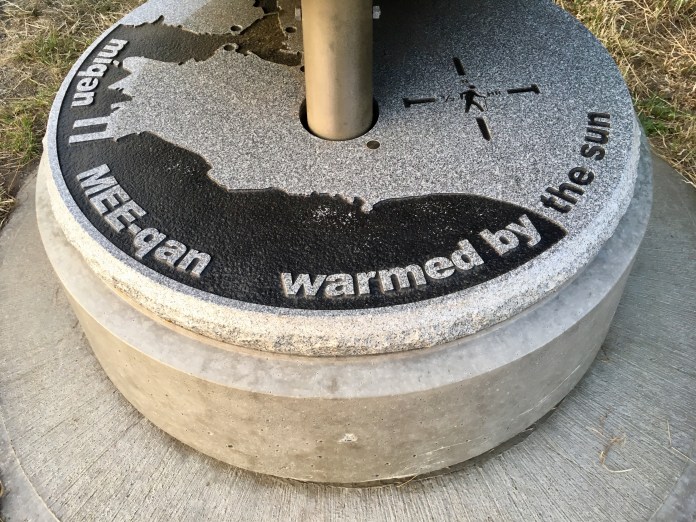
The Lekwungen called this hill MEE-qan or warmed by the sun. At the bottom of the hill was a small, palisaded village that was occupied intermittently from the 11th to 18th century.

You can learn more about the harvesting and cooking of the bulbs of the Camas lily here and here. And UVic’s Martlet has a lovely write up about the first time a Songhees-led pit cook was done on a Parks Canada National Historic site.
In your travels this summer what have you discovered about the First Nations, Inuit or Métis people who were there or still live in the region you visited?

 December 6th marks a tragic day in Canadian history. Fourteen young women were murdered in Montreal on this day 26 years ago. We take time today to remember women and girls who have lost their lives through violence and who suffer from abuse in their lives right now. We can take action by speaking up about violence and by encouraging people who commit violence to get help.

 A Sparrow's Cry